

The boxes arrived faster than the unpacking. Last night, we started unwrapping the pictures, choosing what will stay with us another cycle, what won’t. What fits this new house and chapter, what is too attached to another time, another self.
We’ve been in the new house a month now, and most days I open a box expecting one thing and find another — a set of glasses I forgot we owned, a child’s drawing, a cable for a device that no longer exists. Each box is a small negotiation with the person who packed it, over a year ago, in another life, in another house. She kept this. She thought this mattered. Did it?
In between the boxes, we’ve been wandering the antique markets that seem to multiply when you move to the countryside — there are more of them than I knew existed, entire barns of other people’s past lives (and an awful lot of sheer junk). It’s a bit daunting.
Somewhere between the packing and the browsing, I’ve been reflecting on friends’ multiple Q3 choices: downsizing, upsizing, rightsizing. In the middle of my own sorting, exploring and (re)decorating, I noticed a pattern among the friends and writers I admire (and read): change, at this stage of life, isn’t the exception. It becomes, if you embrace it, the pace and the project of later life.

The bush that got cut back — hard
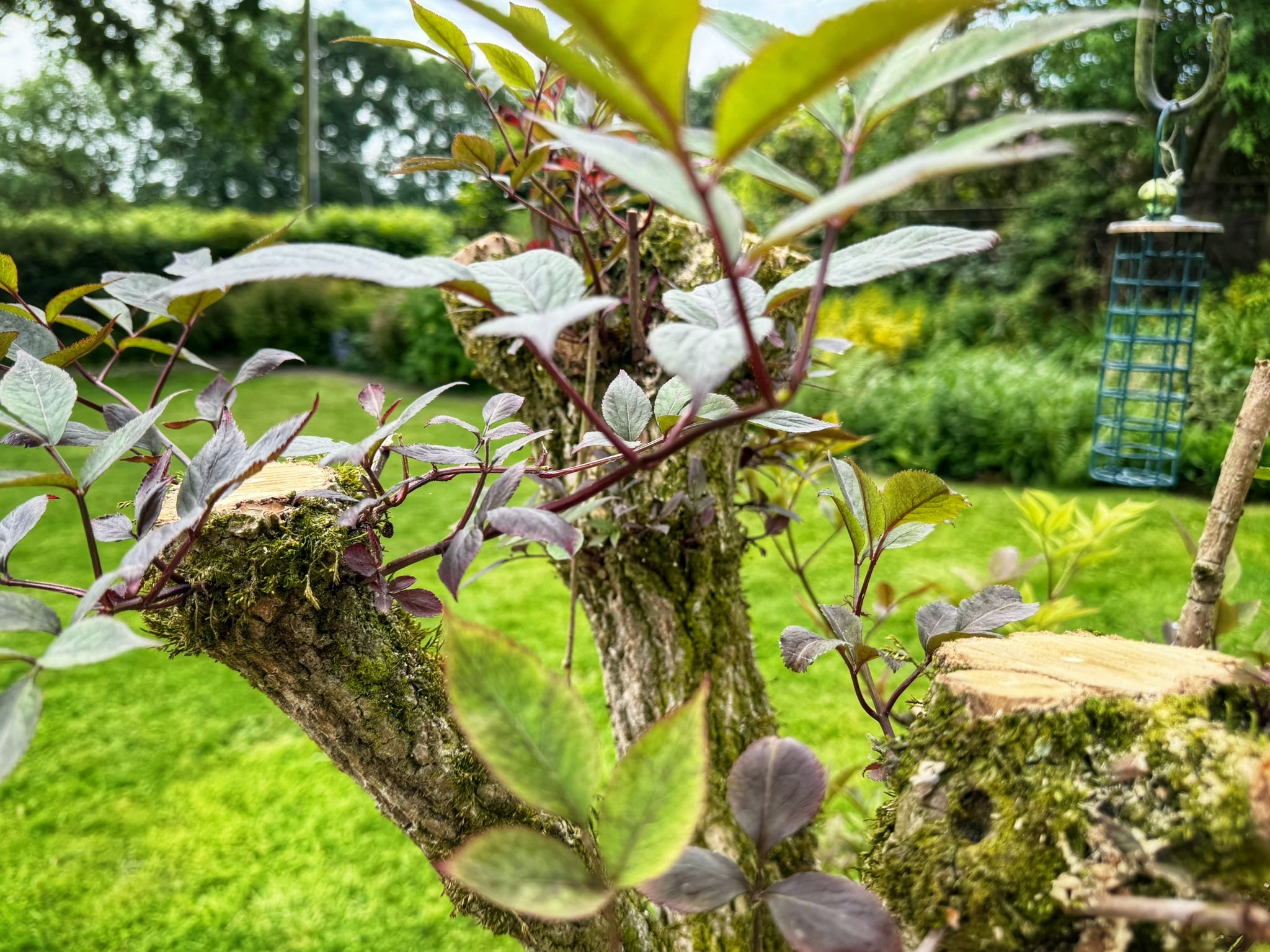
As I discovered last week, just outside the front door, there is (miracle of miracles) an elderberry bush. When we arrived, it was leggy and dying — reaching skyward in all directions, overstretched and unkempt. The gardener who came to check our trees took one look at it and reached for the loppers.
I winced. It looked, for about a week, like an act of violence. Stumps where there had been branches. Bare wood where there had been green. And then, almost immediately, it started to grow back — thicker, greener, more itself than it had been in years. Its new leaves are shiny and a dark vibrant purple.
Hard pruning isn’t punishment. Gardeners know this in a way the rest of us tend to forget about our own lives: a plant that is cut back hard, at the right moment, doesn’t shrink. It redirects. All that energy that was being spent maintaining too many thin branches gets concentrated into fewer, stronger ones. The bush isn’t recovering from the cut. It is responding to it.
I think that is closer to what this move actually is, underneath the boxes, the debates over paint colours (fresh artichoke!) and the endless trips to the tip. Not upsizing in the sense of more stuff. A simplification of form and function. A focusing of energy into fewer, stronger branches.
The oak and the ivy
There is a magnificent old oak at the heart of the garden, which gives the house its name: Oakdene. When we arrived it was being half-strangled by ivy. Thick ropes of it, wound round and round the trunk, trunks feeding on trunks, climbing higher every year, finding every gap in the bark to grip into. From a distance it almost looked decorative. Up close, you could see what it was actually doing: slowly, patiently, stealing light and air.
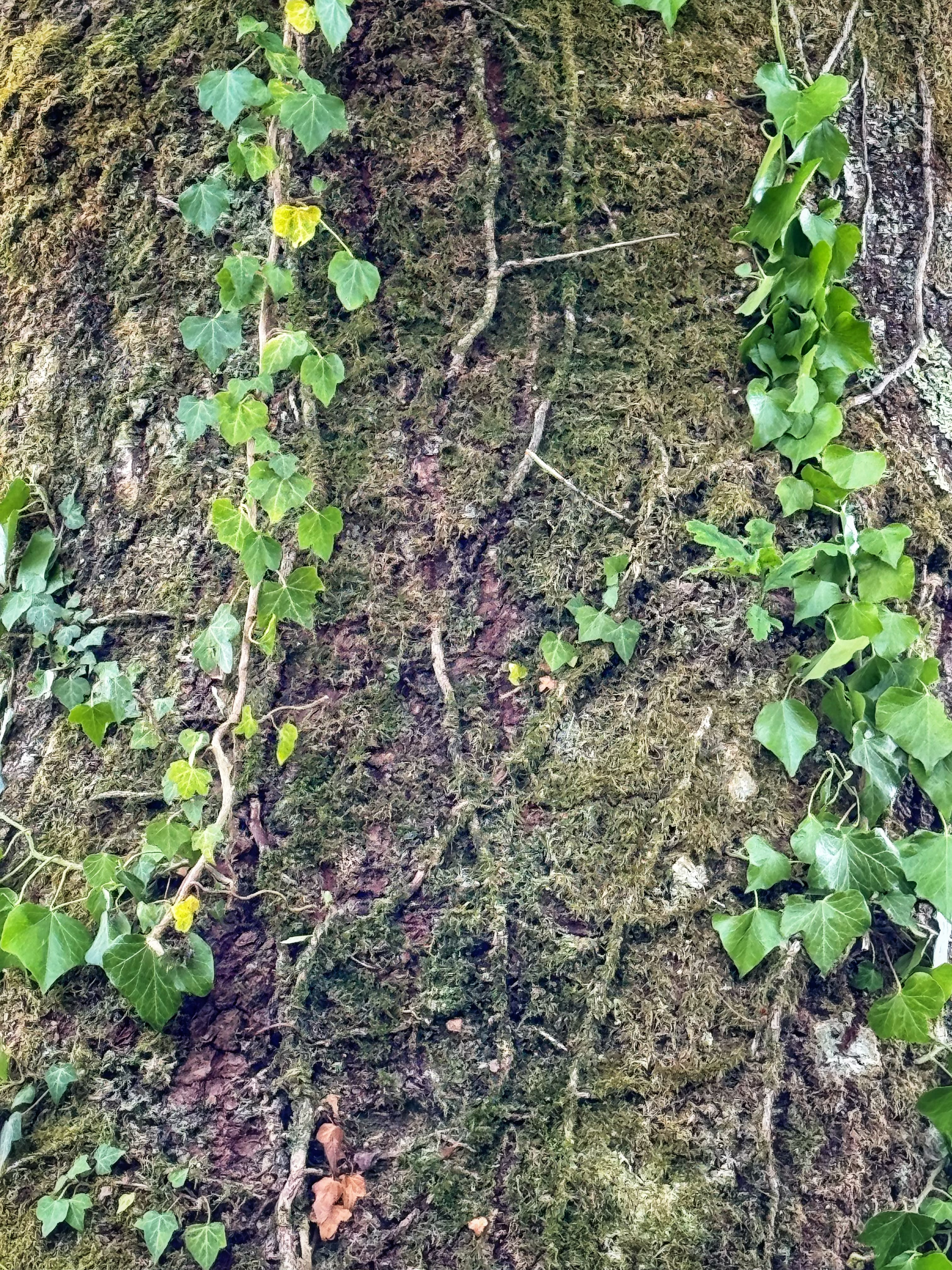
I spent an afternoon sawing it off. It came away in long green coils, far more of it than the tree seemed able to hold, and underneath — paler bark, breathing room, the oak that had been there — resisting — all along.
As I pulled it off, in what felt like a small liberation exercise, I thought: this is what overly routine lives and habits can do to us. Wind round us and asphyxiate new routes and new growth, outward and upward.
Not the big betrayals. The small ones. The same route to the same shops. The same chair, the same hour, the same opinions rehearsed in the same order. The version of yourself that years of repetition have quietly built — useful once, comfortable now, and gradually closing off every direction except the one you have already gone. None of it looks like much, any single strand of it. But ivy doesn’t kill a tree with one rope. It kills it with patience — winding, climbing, never quite letting go, until one day the tree can no longer reach the light it needs.
Q3 is, among other things, the moment you are finally strong enough to notice your own ivy. And to start sawing.
The changers
Once you start looking for it, change in Q3 is everywhere — and it is rarely the change people expect. Here’s a tiny smattering of what I’m seeing around me:
Eleanor Mills, who started NOON, a network for 50+ women, recently sold the big family home — the one built for a household that no longer lives there — to buy herself, in her own words, financial freedom and flexibility in this new, emptier-nest stage. Not a retreat. A release.
Erika Anderson did something that sounds, on paper, more dramatic: she moved from the US to a small town in northern Spain, where she didn’t speak the language, and is now learning spanish, exploring a new culture, and visibly thriving — a whole new life, built from nothing, in her 70s.
And then there is my friend M., who just moved to Milan — part of a much larger tide I read about in this week’s Economist. The world’s wealthy migrating in record numbers, chasing tax regimes and lifestyles and, often, a version of exactly this: a life redesigned, mid-flight, on their own terms.
Three different moves — a smaller pad, a foreign language, a new city — and underneath each, the same impulse. Not running from something. Reaching for something. Exploring, renewing, redefining. And loving it.
Or not moving at all
Some smart change I bumped into this week required no removal van whatsoever.
On my way between a speaking engagement in the Cotswolds and a day teaching at Oxford Saïd, I stopped to see my friend Dr Lucy Ryan (author of Revolting Women). Lucy has decided, very deliberately, not to move — and instead to redo the whole house. Everything that was grey is becoming — colour. Every room, reconsidered. While I was there, I sat in the loveliest, sheepiest chair in her new living room, and by the time I got home I had ordered the same one for my study. (It’s the Shearer, from Loaf, if you’re curious.)
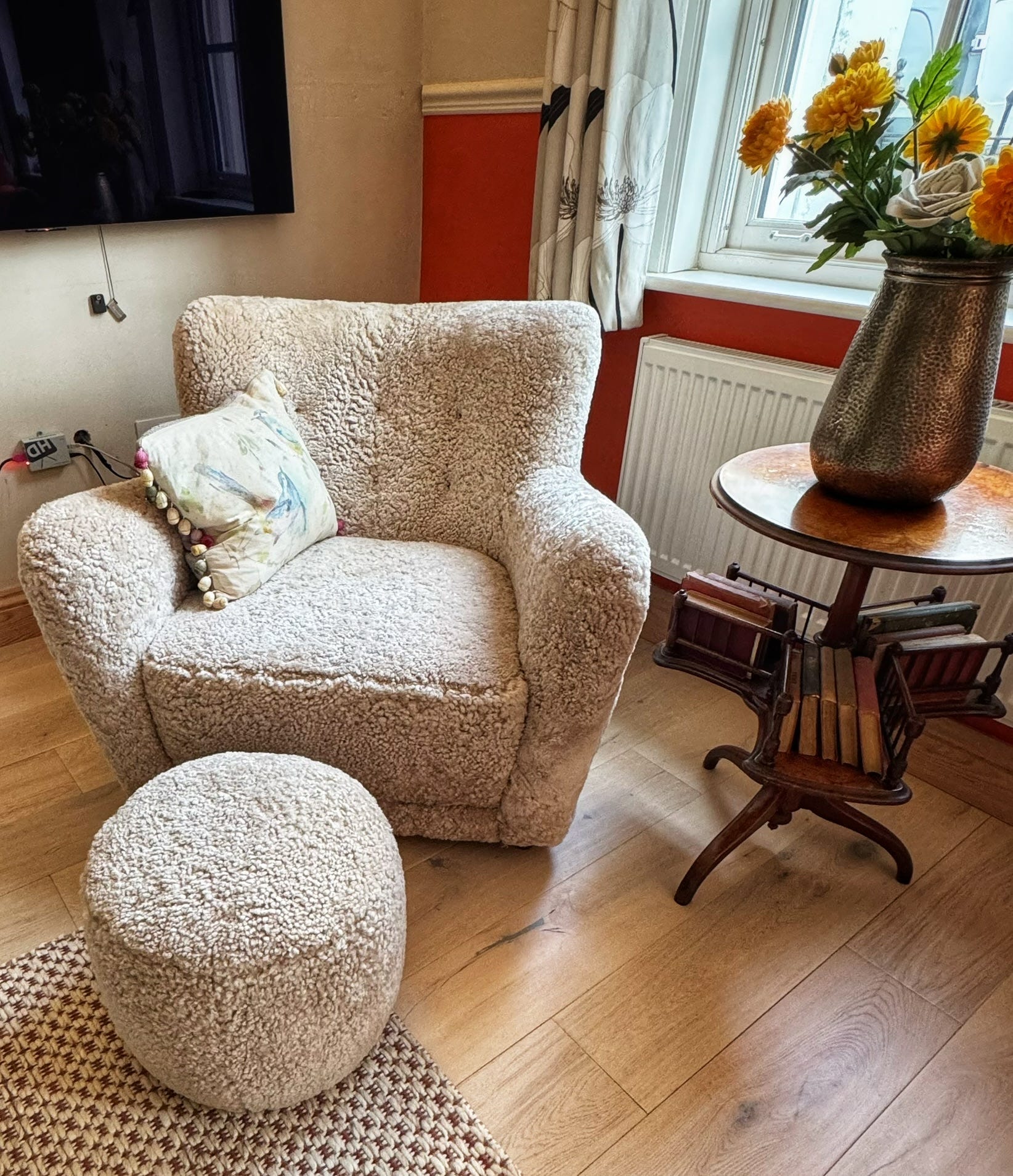
Lucy’s house hasn’t moved an inch. But it is becoming a different house — on purpose, room by room, colour by colour. That’s growth too. Maybe it’s the harder kind: choosing to transform the place you already are, rather than going somewhere new to change the place (and person) you were.
The long view
And then, this week, my friend Jane Trombley — who writes Life in the 4th Quarter — posted about downsizing in her later 70s, having upsized at 68. Buying bigger, for the grandchildren and the gatherings and the guest rooms that get used — and now, a decade on, recognising that the next right-sized life is smaller again.
Reading it, I recognised the shape of something I’ve been smelling out: this house we just moved into, with its rooms for grandchildren and its garden for growing into — I can already imagine, in a decade or two, doing exactly what Jane is doing now. Loving it fully while it fits. Then, when our granddaughters are grown and the rooms are quiet again, choosing to become smaller once more.
Upsizing and downsizing aren’t opposites. They’re the same instinct, pointed in different directions, at different moments. The instinct is the one that matters: the willingness to keep asking whether the container still fits the life — and to change the container, rather than quietly shrinking (or expanding) one’s life to fit it.
The woman who sold us this house
The woman we bought this house from is 80. She’d lived here less than a decade — she and her husband had bought in their 70s, a bit older than us, as a lovely place to enjoy olderhood together. Her husband died a year ago, suddenly, after having just finished trimming the garden hedge. For her, it was time to move again, closer to her son. Different chapter, different needs. I wouldn’t want to live in this house on my own either, it’s too big, with too much environmental machinery it will take me years to figure out.
I think about her often. Walking these same rooms, deciding what to keep and what to let go of at 80, the way I’m setting it all up now in my mid-60s. She felt, in a way I didn’t expect, like a glimpse of a future self — not a cautionary one, rather a companionable one. Another nudge from the universe, reminding me to enjoy this chapter, because it too will end.
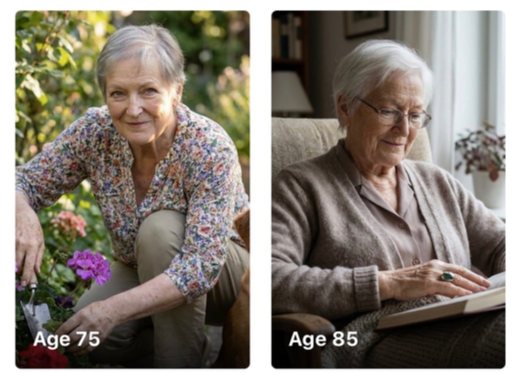
There’s a new tool, from the Portuguese insurer Fidelidade, that invites you to do something similar. It’s the dream-child of my friend Mafalda Honório, one of the alumni of the Longevity Leadership Programme in Lisbon. You answer a few questions about your habits, routines, and choices, and it generates a visual and narrative projection of a future you: not a prediction, but a provocation. What does your face look like at seventy-five? At eighty-five? More importantly — what is that person doing? Who are they spending time with? What have they just changed their mind about?
You can try it yourself — it takes about ten minutes — at longevitybyfidelidade.pt.
I did. Here are two images of me, in ten and twenty years’ time. At 75, still out in the garden, secateurs in hand, doing exactly what our gardener did to that elderberry bush. At 85, comfortably ensconced in that wonderful new armchair with a book, entirely at ease. Neither image is sad or static. At 75, I’m mid-cut, still deciding what comes next; at 85 I’ve chosen, deliberately, what to spend this hour on. Both versions of my future self are still choosing. That’s the thing the 80-year-old who sold us this house understood, and the thing I want to remember when I am her age: the choosing doesn’t stop. Only the scale of it changes.
The nourishment of change
What strikes me, looking at all of this together — the bush, the ivy, the movers, Lucy’s colours, Jane’s second downsizing, the woman who sold us her home — is how young it all looks. Not young as in age. Young as in curious. Young as in still willing to find out what happens next.
We tend to assume that the changes worth making happen early — the big leaps of our 20s and 30s, the years when everything was still being decided. And that by Q3, the decisions are mostly behind us, the shape of life mostly set, and what remains is maintenance.
But maintenance isn’t what any of us are doing, much to our collective surprise. We’re still building. Still adjusting. Still, gloriously, mid-renovation — whether that means less money or more, a smaller house or a larger one, a new language or a newly painted room.
The elderberry bush outside my window didn’t know, when the loppers came out, that it was about to have its best year. It just responded — the way living things do — to what changed. Maybe that’s the point. Not courage, exactly. Just the willingness to respond, and to keep responding, for as long as we get to.
What change are you contemplating? Are you surprised by how much movement there is in Q3?
Avivah, I love your description of the ivy and the oak (punching above its weight). It’s the perfect metaphor for how routine keeps us tied to the past in deceptively beautiful ways. I’m sure your oak is silently thanking you for its liberation
I thank you for the lovely shoutouts.
I also took your suggestion to do the Fidelidades "futurizing" exercise. Some of it didn't work at all (their version of me at 75 looks about 10 years older than I am now, with long flowing hair - seems unlikely that will happen in 8 months ;-) ). But I LOVE their picture of me at 100! If I could figure out how to put it in this comment, I would. xox