
Two Voices, One Question
Gender Differences in Ageing

Happy International Women’s Day.
I spent a few decades of my life working on gender issues, first as Founder and first President of PWNGlobal which is still going strong, flourishing and celebrating its 30th birthday this year, just like my daughter. Then as a consultant, writer (3 books + 3 graphic books), nudger, speaker (3 TED talks!), lobbyist and generally relentless pusher of change.
I’m delighted to see some of the amazing women and men who’ve taken over the baton, and since I can’t list all of them, I’ll flag one of my favourites. Don’t miss Alice Evans, now at Stanford, and her upcoming book on The Great Gender Divergence (published by Princeton University Press). She’s brilliant, global and absolutely essential. The Economist featured her this week, and you can follow her on Substack too. I do.
I’ve moved on the past 7 years to a focus on longevity, ageing and demographics. But find I’m ever fascinated by the overlay of gender everywhere. So today, I thought I’d take a look at some gender differences in ageing - and how men and women think and write about it. Even experience it. I’ll do more writing about this over the coming years, but here’s a start.

Two Of My Favourite Voices on Ageing
As I prepare to turn 65 this summer, I find myself increasingly drawn to the voices of people navigating the last stretch of Q3 — the 65 to 75 decade, when achievement begins to soften and something quieter starts to emerge. There seems to be a pattern in these years. A subtle drawing inward. A loosening of old identities. A renegotiation of ambition, partnership, relevance and purpose. I can feel that gravitational pull myself. An insistent call to slow down and listen - to my body, my energy, my evolving motivations in the midst of global mayhem.
The two writers below are asking the same question from different angles: Who am I without ‘work’? Btw, I think the word ‘work’ needs a major rebrand, like ‘old.’ It’s too often conflated with money and worth and particularly deadly when paired with the word ‘still.' But I digress. Reading my two favourite Q3 writers side by side feels like watching late ‘Becoming’ unfold in real time.
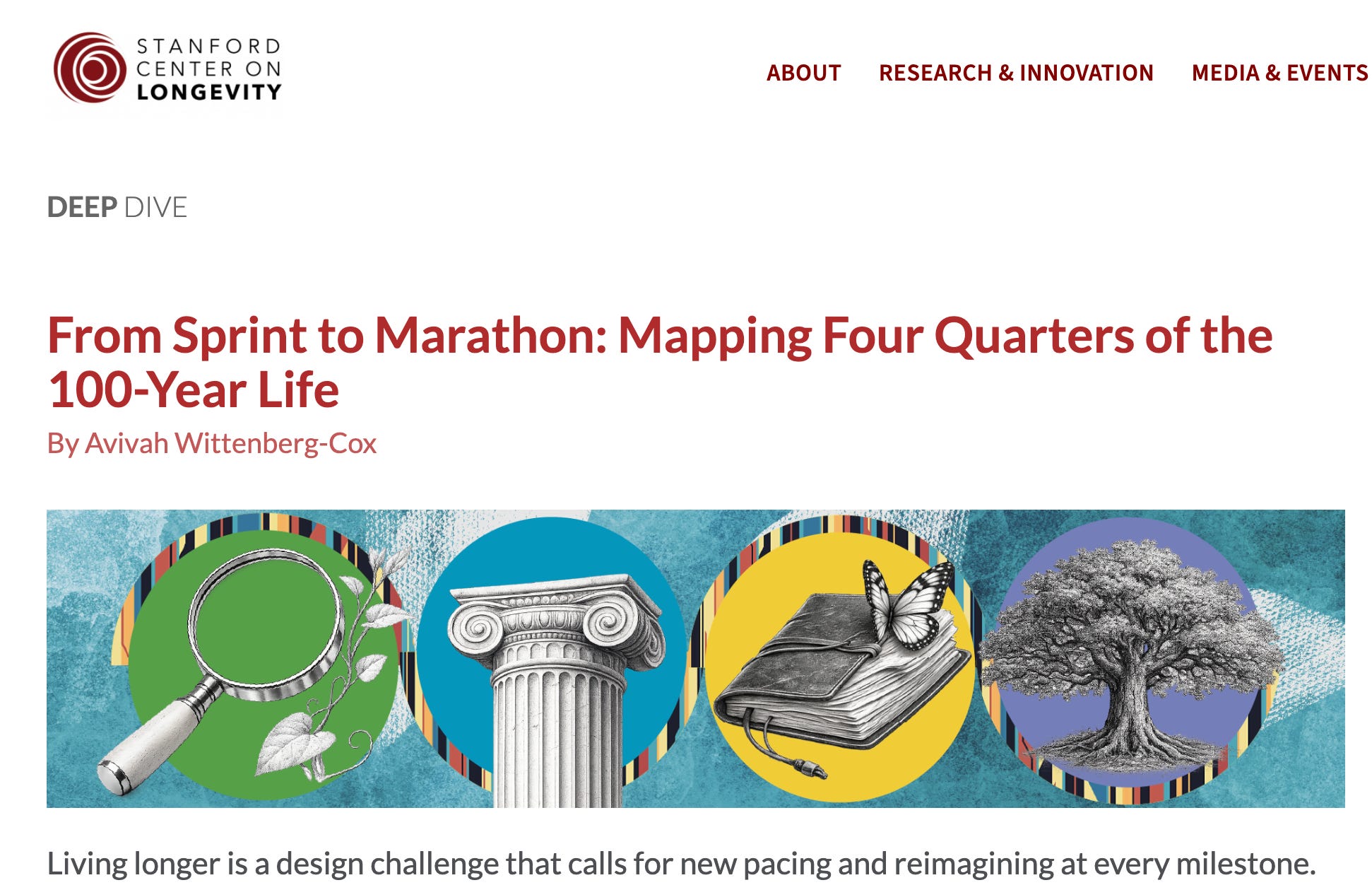
(For a beautifully illustrated reminder of my 4-Quarter model, and the transitions between them, here’s a just-published article in the Stanford Center of Longevity’s new magazine).
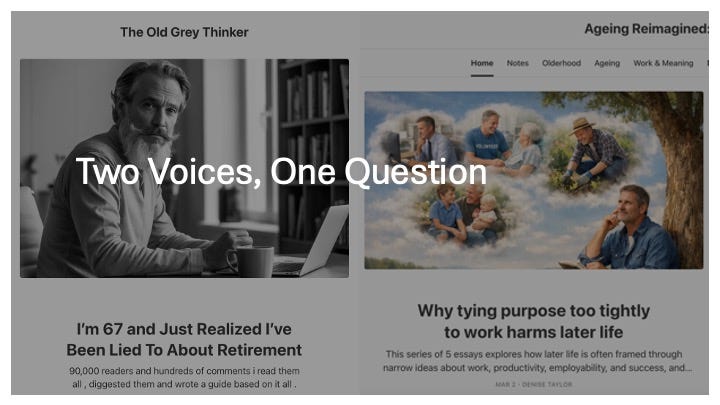
One writer is The Old Grey Thinker. A pseudonym. A persona: a retired naval commander navigating retirement, masculinity, and meaning. He writes frequently — sometimes every day. In what felt like the blink of an eye, he gathered more than 10,000 subscribers on substack.

The other is written by Denise Taylor, under her own name, at Ageing Reimagined. She has fewer than 2,000 subscribers. She writes (a bit) less often. Slower. Thoughtfully. She is stepping into her late 60s and has chosen to stop working for money after 52 years of doing exactly that.
The Differences, The Similarities
He is prolific. Structured. Almost certainly AI-assisted. Publishing at pace. Selling guides about how to harness AI to monetise your knowledge in retirement.
She is reflective. Personal. Writing without commercial urgency. She recently bought a woodland retreat and divides her time between quiet reflection there and writing multiple book projects. She is explicit: she is no longer working for money. That decision, after five decades of earning, has given her time — and space — to think.
Annoyingly, almost predictably, the armoured captain has five times the audience. The gender differences are apparent in the narrative, the process, almost certainly their readership. And yet the deeper I read, the less different they seem. Because the question they are asking is exactly the same: Who am I without work?
Strip away the naval persona and the money-making guides, and he returns again and again to that same ache. He sounds like a lot of the men I know and coach. Hit by retirement, unaccompanied on the transition, and totally unprepared. He writes about waking up without a mission. About the disorientation of no longer being needed in the same way. About the subtle shift in couple dynamics: the man adrift, his wife still purposeful, still moving, still engaged.
Some of his strongest pieces are about home. About sitting at the kitchen table feeling peripheral while his wife remains busy and central. About the quiet humiliation of losing relevance inside one’s own household. There is no neat resolution in his posts. They circle. They leave threads open. They confess uncertainty and vulnerability rare in men’s writing.
I invited him onto my podcast recently. He declined. He prefers to keep a low profile, to remain behind the constructed persona. The naval commander exists; the man behind him does not.
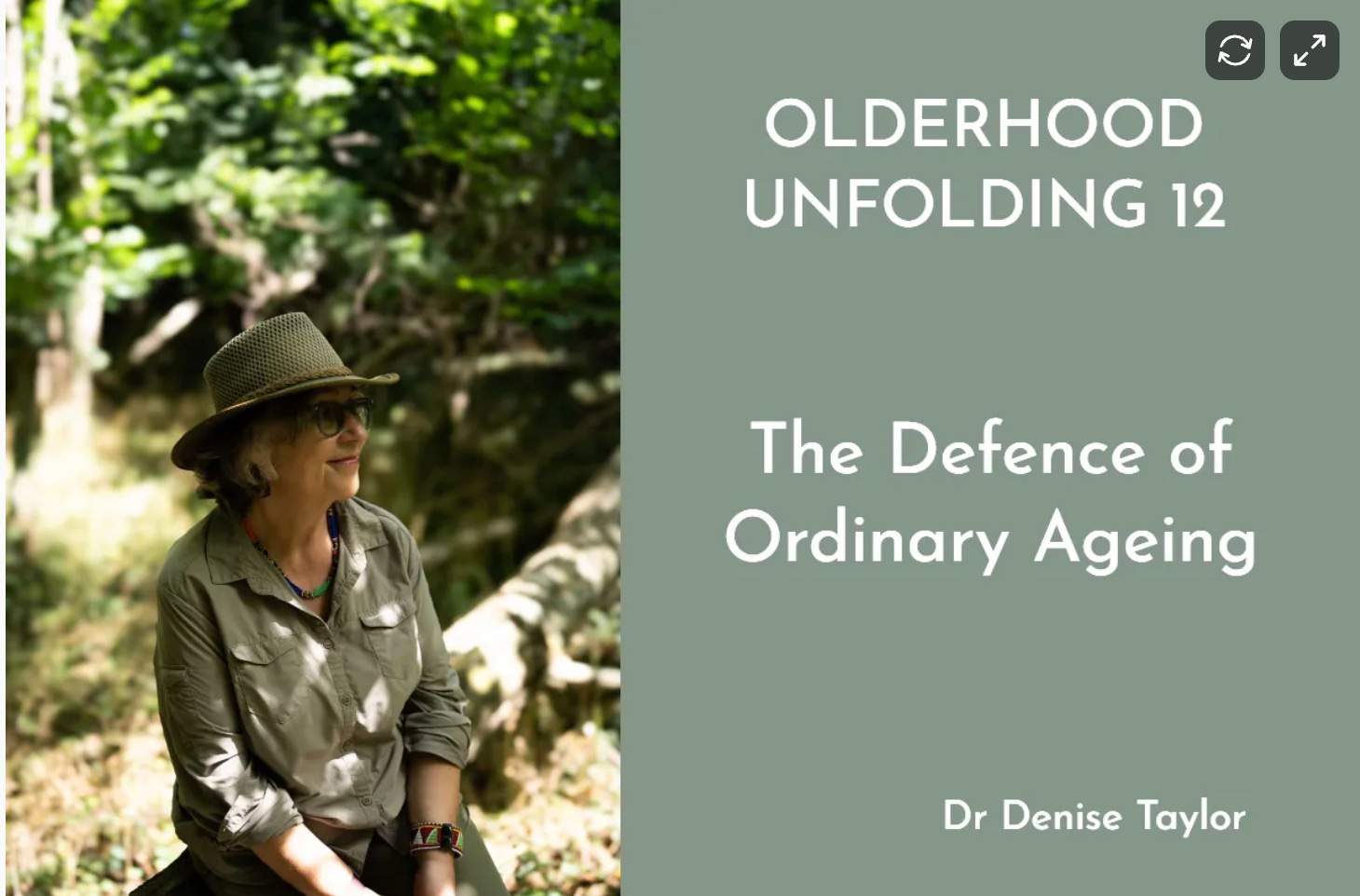
Denise, by contrast, joined me for a long conversation. We spoke between her time in the woods she has bought and the writing projects she is incubating (her new book, Thrivespan, will be published this spring). She is shedding structure deliberately. She stopped working for income not because she had to, but because she chose to. After 52 years of earning, she is experimenting with a different orientation to time.
Yet she circles the same terrain.
Without the scaffolding of productivity, who remains?
What ambitions were authentic, and which were inherited?
What happens to partnership when one person steps out of the arena and the other continues?
Different tone. Same excavation.
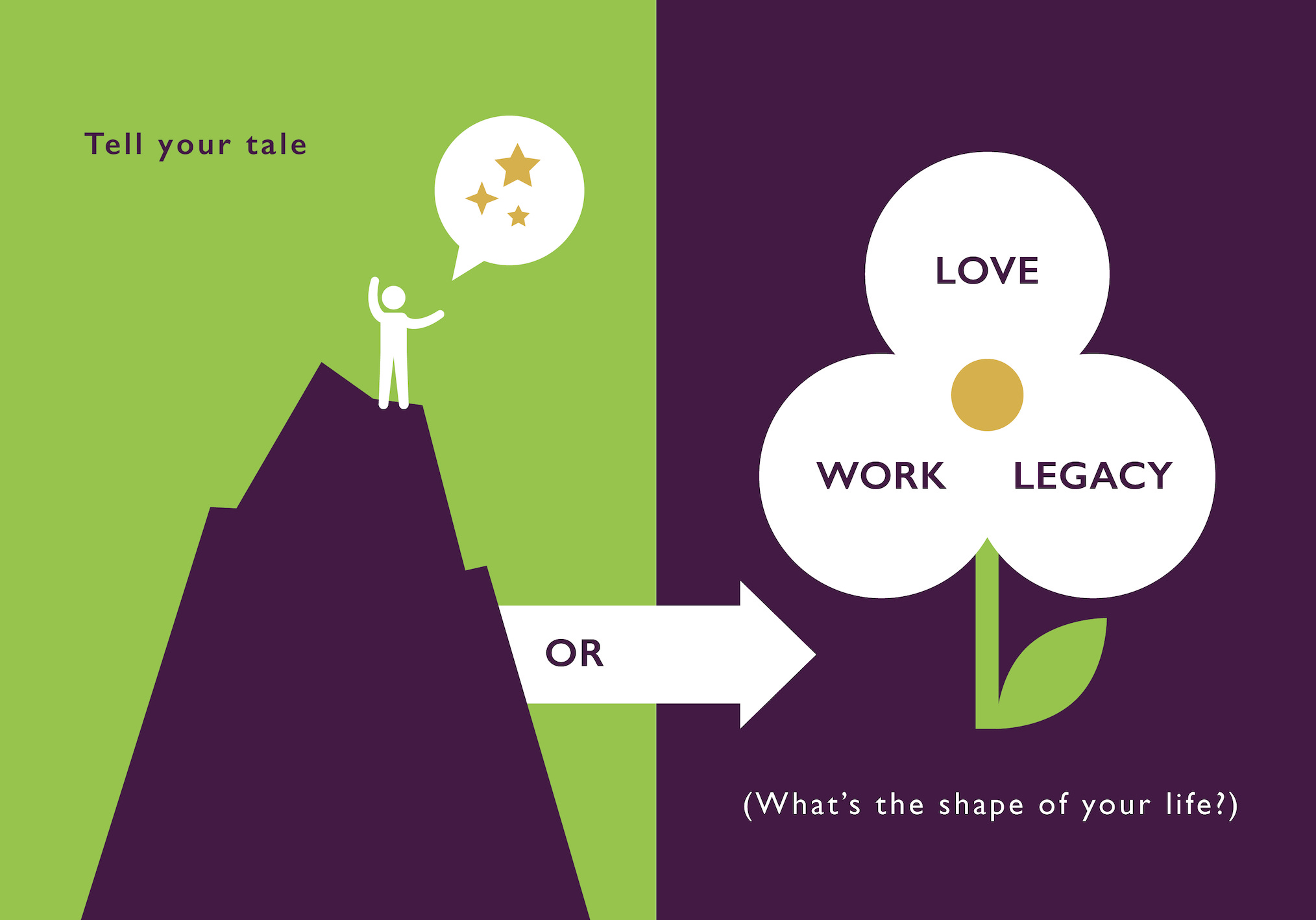
What fascinates me is not just the gender contrasts in tone and journey as the gendered languages they use to approach the same inner shift. He builds structure around uncertainty. He writes often. He frames himself as a commander. He uses systems — including AI — to create coherence around drift. Monetisation may be practical, but it is also symbolic: proof of ongoing relevance.
She dismantles structure to examine uncertainty. She slows down. She removes titles. She allows the identity blur to stay blurry. She is not rushing to replace one mission with another. She refuses money as a measure. They remind me of this contrasting image of typical ways men and women frame their life narrative’s, from my Thriving To 100 book:
Preparing to Let Go
Both are beautifully done. Both feel honest. And both feel like preparation. Preparation for that late stretch of Q3 — the later 60s and early 70s — when achievement energy naturally begins to soften. When we are not yet harvesting, but may want to loosen our grip. When the external markers that defined Q2 and early Q3 no longer automatically generate meaning.
There is a letting go that comes for all of us. For some, like Old Grey, it feels like being demoted by time. For others, like Denise, it feels more like a release. But the questions underneath are similar.
Who am I when I am no longer driven by output?
Who am I when I am not needed in the same way?
Who am I when my partner’s trajectory diverges from mine?
Reading them side by side, I see emerging parts of myself in both. The part that wants to stay productive. To systematise. To use new tools. To scale thought. To remain relevant. And the part that is curious (and increasingly attracted) to shedding. Doing less. About allowing identity to reorganise from the inside rather than replacing one platform with another.
It would be easy (and always tempting) to reduce this to a neat masculine-feminine contrast. The armoured producer versus the reflective seeker. The monetiser versus the metaboliser. But life is rarely that tidy. Many women cling to output. Many men sit quietly in existential doubt. What may be shifting now is not just gender roles, but the choreography between them — especially in couples.
One partner slows. The other accelerates. One reinvents outwardly. The other inwardly. One builds. The other dissolves. And then, sometimes, they swap.
Late Q3 Transitions
What these two Substackers offer — quite unintentionally — is a live study in late midlife transition. They are both rehearsing the same surrender. The surrender of centrality, of career as identity, of being defined by achievement. AI, productivity systems, book publishing and monetisation may cushion the fall. Reflection and time in the woods may soften it. But neither avoids it.
The last chapter of Q3 is not about scaling higher. It is about recalibrating inward. It asks us to loosen ambition without losing vitality. To stay engaged without being driven. To remain curious without needing applause. Perhaps that is why I read them both.
Old Grey reminds me that structure still has power. That discipline can steady drift. That tools are not the enemy. Denise reminds me that there is no shortcut through identity shedding. That meaning cannot be industrialised. That slowing down is not failure. Between them, I glimpse something truer than either alone.
Reinvention in late life is not about becoming someone new. It is about discovering who remains when the roles fall away.
And that is work — even when we are no longer working.
Happy Birthday in advance Avivah! With my firstborn turning 64 next Saturday, the question that comes to me is: is your mother still alive? One of the greatest joys of having the privilege of living 87 years is not only witnessing but accompanying both of my daughters as they have become who they are: brilliant, compassionate, beautiful, loving, accomplished—lovers of art and music, the earth and all living creatures on it. I would imagine your mother, if she is still with us, would feel the same way about you and about her good fortune. Happy Birthday!🎂🎊🎁🎉🎈
I love how you think, even when I sometimes disagree with you.
I do agree that Old Grey feels very male/yang in his approach and Denise very female/yin.
However, I’ve pretty much stopped reading OG because each of his posts just started to feel like complaints to me - and like he’s not really looking to resolve or address his feelings of purposelessness and lack of recognition by society. It just feels like bitching. A much more engaging (and better-written) version of all the old guys sitting around in the diner talking about how bad things are.
Complaining engagingly is definitely a good way to get followers (“why, that’s just how I feel!”), but I’m not a fan.
I much prefer to read people like you and Denise, who are authentically looking for understanding and resolution. Who are trying to create paths for themselves and others.
Carry on ! 😏