
The Q3 Career
The ladder didn’t disappear. You just stopped needing it.

MAPPING THE NEW Q3 · Sunday Elderberries · Week 9
Something shifts when you move from understanding Q3 to actually navigating it. That’s what we’ll be looking at in the last four weeks of this series.
The first shift is internal — all that leaving and looking and loving and leaping. The second shift is external. At some point you look up from all that necessary interior work and realise: you have to figure out what you’re actually doing now.
Not in the existential sense. In the practical, Tuesday-morning sense. What is your work? Where does it live? Who does it serve? What shape does a day have, a year have, a decade have, when the old containers no longer apply?

The container problem
For most of us, the career was the container. It held the identity, the schedule, the social life, the sense of progress, the answer to the question strangers ask at dinner parties.
And then, somewhere in Q3, the container becomes optional. Or actively constraining.
Not immediately. Not cleanly. But something loosens. The work that used to feel like the whole of you starts to feel like part of you. Or part of who you used to be. Which is, on balance, a relief — though nobody quite prepares you for the vertigo of that relief.
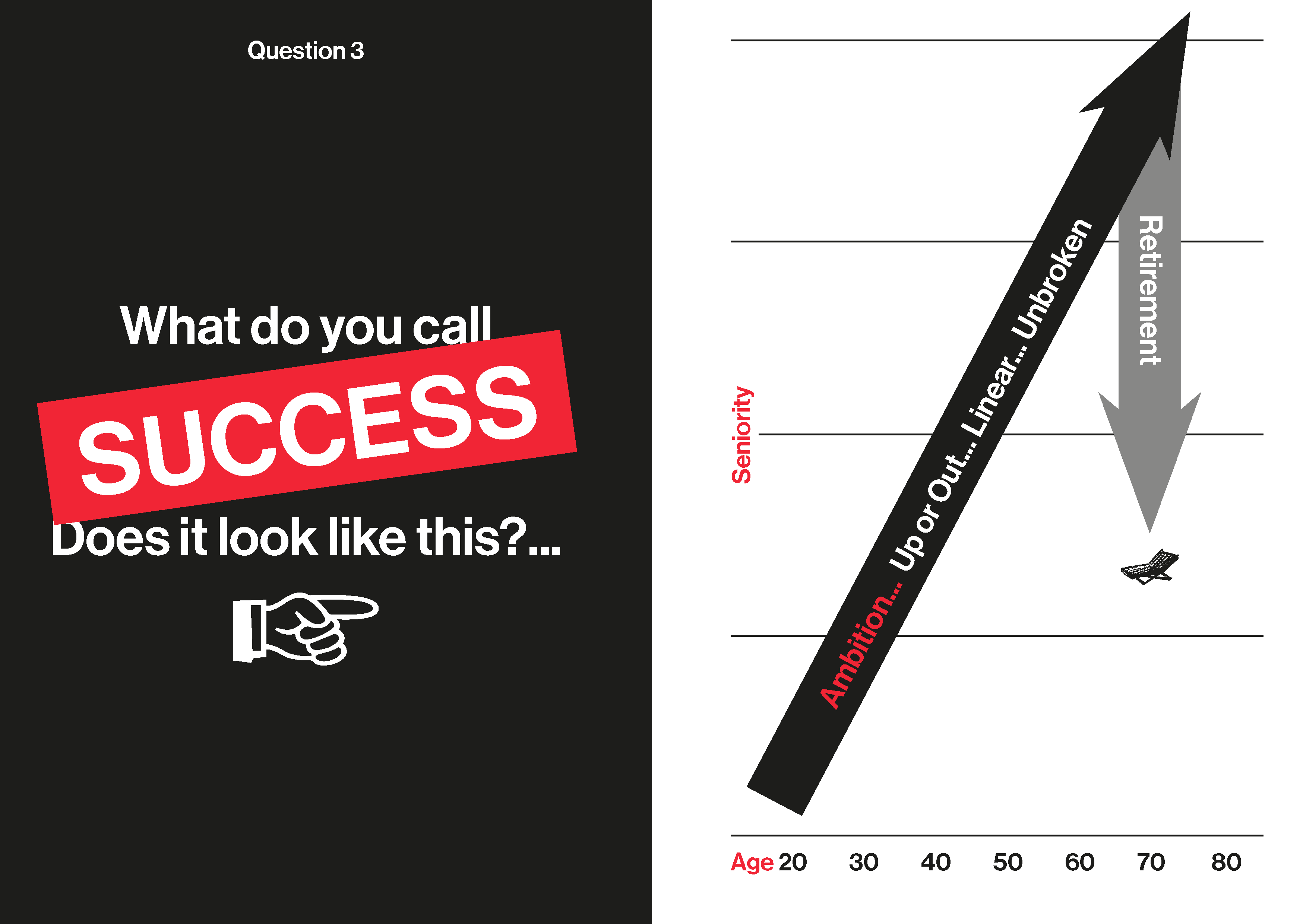
The old container was the ladder. It had rungs. You knew where you were on it. You knew what the next rung looked like, even if getting there wasn’t guaranteed. The ladder was legible. It had grammar. Even if you hated it, squiggled through it or failed at climbing it.
Q3 is when the container cracks
Not because something went wrong. Because you got there. Because you climbed to the point where the ladder runs out — or you realised the ladder was always someone else’s — or you simply looked around one day and noticed you’d already stepped off, without quite deciding to. (Ladders were never designed with parents or carers or women in mind.)
And then discovered that what’s on the other side isn’t retirement.
The thing that isn’t retirement
Retirement was the other container. The one waiting at the end of the ladder. Complete with golf club, cruise liner or garden.
For a generation or two (not that long, really), the story went: work hard, climb well, and at sixty-five— or thereabouts (70 now in Denmark) — stop. Collect the watch. Cultivate the garden. Read the books you never had time for.
It was always a slightly thin story. Now it’s also a dangerous one.
When lives routinely reach into the eighties and nineties, a retirement at sixty-five means potentially three decades of not-working. That’s longer than many careers. The maths (and the money) stopped adding up. The psychology stopped adding up. The identity arithmetic stopped adding up entirely. Even the brain recalibrated. The IMF says that a 70-year old brain today is the same as a 53-year-olds in 2000.
So people in Q3 are doing something else. Lots of things, in fact.
Something that doesn’t have an agreed name yet. Something that looks different from the outside than it feels from the inside. Something that tends to get called a portfolio career, or a second/silver/next act, or a pivot, re-invention, re-creation, as though it can be captured by a consulting term or a pithy metaphor.
None of those quite fit. What’s actually happening is something more interesting, and more personal, than any of those labels suggest.
Recognition before intention
Here is what I keep noticing — in the people I talk to, in the conversations I have, in the patterns that emerge from the most interesting lives being lived right now in Q3.
The Q3 career rarely begins as a plan. It begins as a recognition.
At some point, you look at what you’ve been doing — the projects you kept saying yes to, the conversations you never wanted to end, the work that felt like relief rather than effort — and you realise you’ve already been building something. You just hadn’t named it yet.
The naming comes second. The construction was already underway.
What you were doing was following some internal signal — some quiet frequency that had always been there, underneath the noise of the ladder and the promotions and the performance reviews. Q3 is when the noise finally drops enough to hear it clearly. Sometimes it drops you.
And what you hear is surprisingly specific. Not “do something meaningful” — that’s too vague to act on. And I’m tired of the ‘purpose’ word. Something more particular. The specific intersection of what you know, what you love, and who you want to spend time with. Maybe what the world needs. The thing that didn’t quite fit inside the old container. The thing that kept breaking the edges of it.
What a Q3 ‘Career’ looks like
No two Q3 careers look the same. That’s both the challenge and the point.
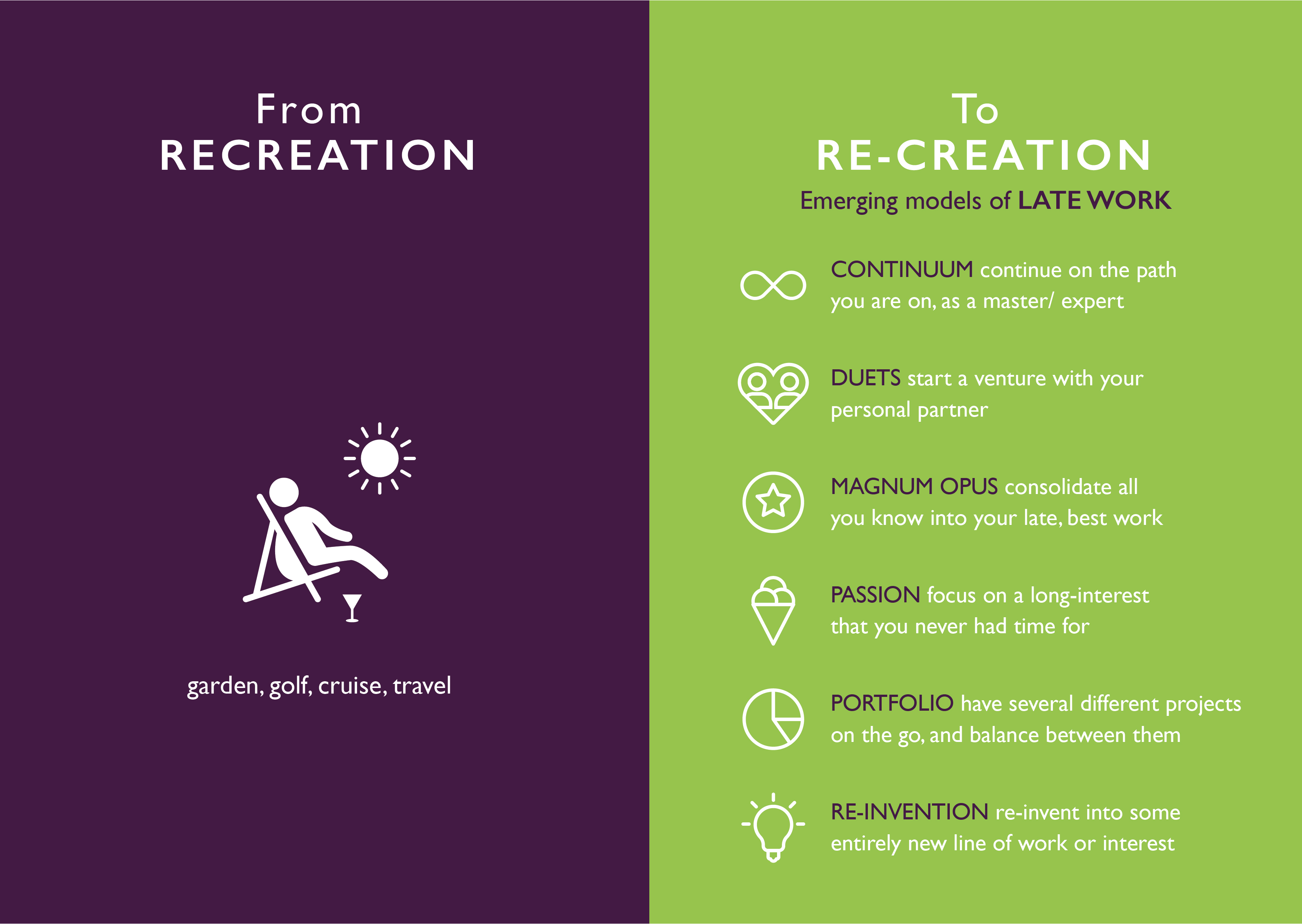
Some are genuinely portfolio — several different kinds of work, held together not by an institution but by a through-line of interest or expertise. Some are the same work, radically reconfigured — fewer hours, different clients, a different relationship to authority, money and output. Some are a complete departure from what came before, which turns out not to be a departure at all when you trace the thread back far enough. Some aren’t categorised as ‘work’ at all.
What they share is this: they tend to be built around the things that couldn’t be accommodated before. The ideas that were too slow for the quarterly cycle. The audiences that weren’t in the target demographic. The questions that were too long-term to pitch to a board. The way of working that required more autonomy than the org chart allowed.
Q3 careers are where those things finally get room.
They also tend to combine things that weren’t supposed to go together. Making and thinking. Teaching and doing. Writing and speaking and convening. The categories that Q2 kept separate — here is your role, here are its boundaries — become suddenly negotiable.
This is, for people who’ve spent twenty or thirty years inside defined roles, somewhat disorienting. It can also be, once you settle into it, quite wonderful.
The hardest thing about the Q3 career is that nobody hands you its shape.
In Q2, the shape was given. Apply here, get promoted there, report to this person, manage that team. Even when you were driving your own career, there was a map. The map was the industry, the profession, the organisation. The way things were done. The map told you what was possible, what was expected and in what sequence.
In Q3, you draw the map
Which means you have to tolerate not knowing what the map looks like while you’re drawing it. You have to stay curious when you’d rather be certain. You have to try things that might not work, talk to people whose fields feel adjacent in ways you can’t quite articulate, follow the thread even when it seems to be leading nowhere.
And then, usually when you’re not looking for it — you look up and realise it’s taken a shape you recognise. Not the shape you would have designed in advance. Something better than that.
Something that fits.
Question: What does your Q3 career look like — or could look like? I’d love to hear what’s taking shape.
Next week: the Q3 couple. Nobody transitions alone — and the most overlooked variable in any midlife career decision is the person sitting across the table at breakfast.
As always, spot on. As an almost lifelong freelancer, I never had to deal with “retirement“ but I have a partner, a former ambassador pushing 72, who is. I passed this on to her. Thank you for breaking it all down.