
Mapping Q3: Looking...
The most misunderstood phase of Q3 is the one where nothing, from the outside, appears to be happening.

Elderberries · Week 6 · Mapping the New Q3
“In the Third Chapter, people are searching — not for certainty, but for a self that is still becoming.” — Sara Lawrence-Lightfoot, The Third Chapter
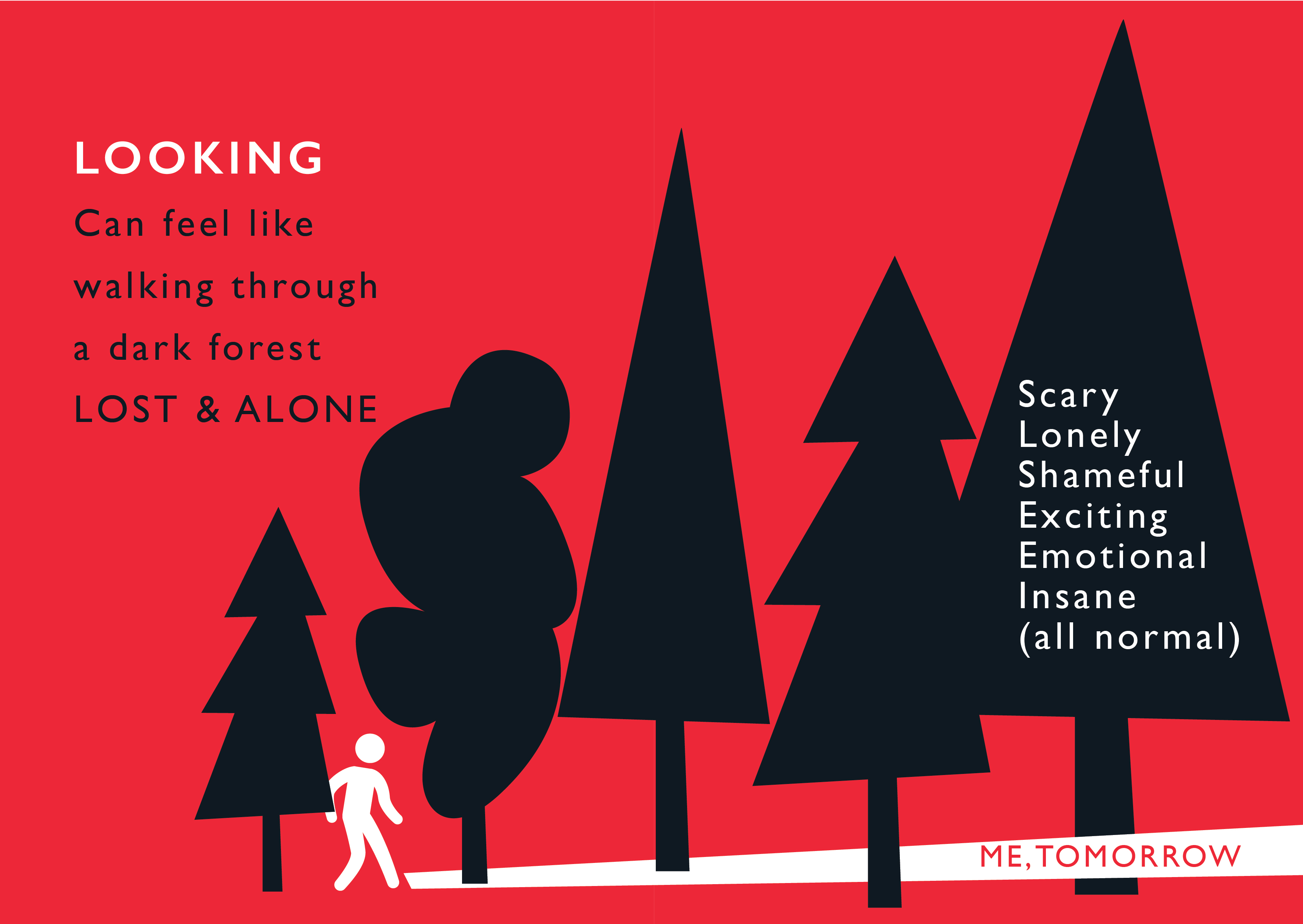
There is a moment in midlife when the old answers stop working — and the new ones haven’t arrived yet.
It doesn’t announce itself clearly. There’s no clean break, no formal ending, just a growing sense that something that once fit no longer does. Work that used to energise begins to feel repetitive. Conversations circle familiar ground. Decisions that once came easily start to stall.
From the outside, very little may appear to have changed. From the inside, everything has.
I’ve come to think of this as the looking phase of Q3 — the stretch of time after something has ended, but before anything new has properly begun. It is, without question, the most misunderstood part of a longer life.
Partly because it doesn’t look like progress.

I’ve looked (at least) three times:
PERSONAL: The first time, I was looking for a way out. Not yet for what would come next — just for an exit from a life that had quietly stopped fitting. I had decided, the new year before I turned fifty, that my decades-long marriage was over. What I hadn't decided was … anything else. The looking that followed was less a search than a permission — to imagine a different kind of life, to let go of the shape I'd been holding. That it landed me on an old friend, unexpectedly, was not something I could have planned or predicted. I wrote about some of what followed, eventually, in Late Love. But the looking itself was not writeable at the time. It was too close, too without edges, too hurtful to too many I loved. And it taught me something I've had to relearn twice since: you rarely know what you're looking for - until you've found it.
PROFESSIONAL: The second time, I was looking for a new professional focus and inspiration after two decades spent on gender balance. I hadn’t run out of things to say. I had run out of wanting to say them. Something in me had finished with that work before the work had finished with me. Burnout disguised as success. The looking that followed was slower, more diffuse, spread over years. It came out of conversations, reading (especially The 100-Year Life by Lynda Gratton and Andrew Scott, a real wake up of a book), of following threads that didn’t yet have names, of realising — gradually — that longevity was the next big megatrend. Similar to gender, but different. First, the rise of women. Then the rise of the old.
HOME: The third time is now. Or almost now. As many of you will know, we’ve been looking for a new home since selling our barn in Somerset — the cosy little love-nest we decided to leave when some potentially nasty and noisy company moved in down the lane. That looking has been its own kind of education: in what we actually need, in what we were attached to without realising, in the difference between a place that was right for who we were then and a place that will be right for who we are becoming next. In the 8 years since we bought the barn, when I was 57, I’m at a completely different place, with different needs. My daughter has moved back to London after a decade wandering the world. My son has married, built a sizeable business or two, and gifted us two gorgeous Glam’Daughters. I’ve become an expert in an entirely new and fast-emerging field of longevity. I’m thinking of doing midlife retreats for couples in the countryside. Hosting little girls over long summer breaks. We complete next week. I’ll tell you about the arriving then.

Each time, the looking felt like a problem. Each time, it turned out to be the work.
We are a culture that understands movement: upward, onward, forward. Promotions, launches, transitions with titles. We know how to recognise those, we reward them, we build narratives around them.
But the looking phase offers none of that. Instead, it brings hesitation, a loosening of certainty, a period where answers are replaced by questions — and not the tidy, strategic kind. The more unsettling ones: what do I actually want now? What still matters? What no longer does?
For people who have spent decades being competent, decisive, in motion, this can feel deeply disorienting. Because from the outside, it can look like drift.
Herminia Ibarra, whose work on working identity is the most rigorous account we have of how people actually change, argued on 4-Quarter Lives last week that we don’t think our way into a new self — we act our way there. We experiment at the edges. We try things that don’t quite fit. We follow bread crumbs of interest and attention that may or may not lead anywhere. We allow ourselves to be temporarily incoherent. From the outside, it looks inefficient, even indulgent. From the inside, it is often the most alive some of us have felt in years.

It ain’t drift. It’s the work of becoming someone new.
Chip Conley — who left a career that had defined him for decades and rebuilt himself as what he calls a modern elder — describes this phase as one of the most generative of his life, and also one of the hardest to explain to anyone who hadn’t been through it. The people around him saw uncertainty. He was paying a different kind of attention. (the 4-Quarter Lives conversation with him republishes this week).
There is a particular quality of noticing that only emerges when you are no longer certain. You listen differently. You become more alive to what draws you in — and what doesn’t. You begin, slowly, to distinguish between what you thought you should want and what actually holds your interest now.
But this requires something our systems — and our identities — are not designed to support: time without definition. Organisations struggle with it. Families (and spouses) worry about it. Individuals themselves often try to shorten it, to rush through to the next clear thing. To a decision.
Which is understandable. Uncertainty and ambiguity is uncomfortable, and not knowing feels like falling behind. But in longer lives, this phase is not an anomaly. It is structural.
Sara Lawrence-Lightfoot, who has spent years exploring what she calls the ‘Third Chapter,’ found that the people who navigate this phase best are not the ones who move through it fastest. They are the ones who stay curious long enough to let something genuinely new emerge — rather than grasping too quickly for the next role, the next identity, the next answer that recreates a version of the life they’ve already outgrown.
The real risk is almost never that people spend too long here. It’s that they don’t spend long enough.

The people who appear, from the outside, to be lost are often the ones doing the deepest, most useful work.
We don’t have a generous language for this phase. We call it drifting, stalling, being in-between — phrases that imply a problem to be solved. Perhaps what we need instead is a different framing: not a gap between two real things, but a phase in its own right. One that requires patience, curiosity, and a certain kind of quiet confidence.
The confidence to remain in motion without yet knowing the destination.
In a longer life, you will likely pass through this phase more than once. I have. The question is not whether you will find yourself here, but whether, when you do, you will recognise it for what it is. Not a failure of direction. The beginning of something you cannot yet see.
Looking is not the opposite of knowing where you’re going. It is how you find out.
Where has looking taken you? And how long did it take before you recognised it as something other than being lost?

This week on 4-Quarter Lives: Chip Conley on the looking phase — what it costs, what it gives, and why the people who rush through it almost always pay later.
This is so good and useful, Avivah.
Looking back, we spent almost 5 years shifting our life from the US to Spain - and it was only last year that we fully realized that’s what we were doing!
And it took me about 2 years to shift into my new (and more appropriate to this stage of my life) relationship with my business -
I am so happy to find this Avivah. Thank you for sharing your thoughts and these resources for a new chapter and (re)finding our confidence as life shifts.